Modeling Baccarat Outcomes Through Markov Chain Techniques
Written by Jonas Becker · Oct 7, 2026
Modeling Baccarat Outcomes Through Markov Chain Techniques
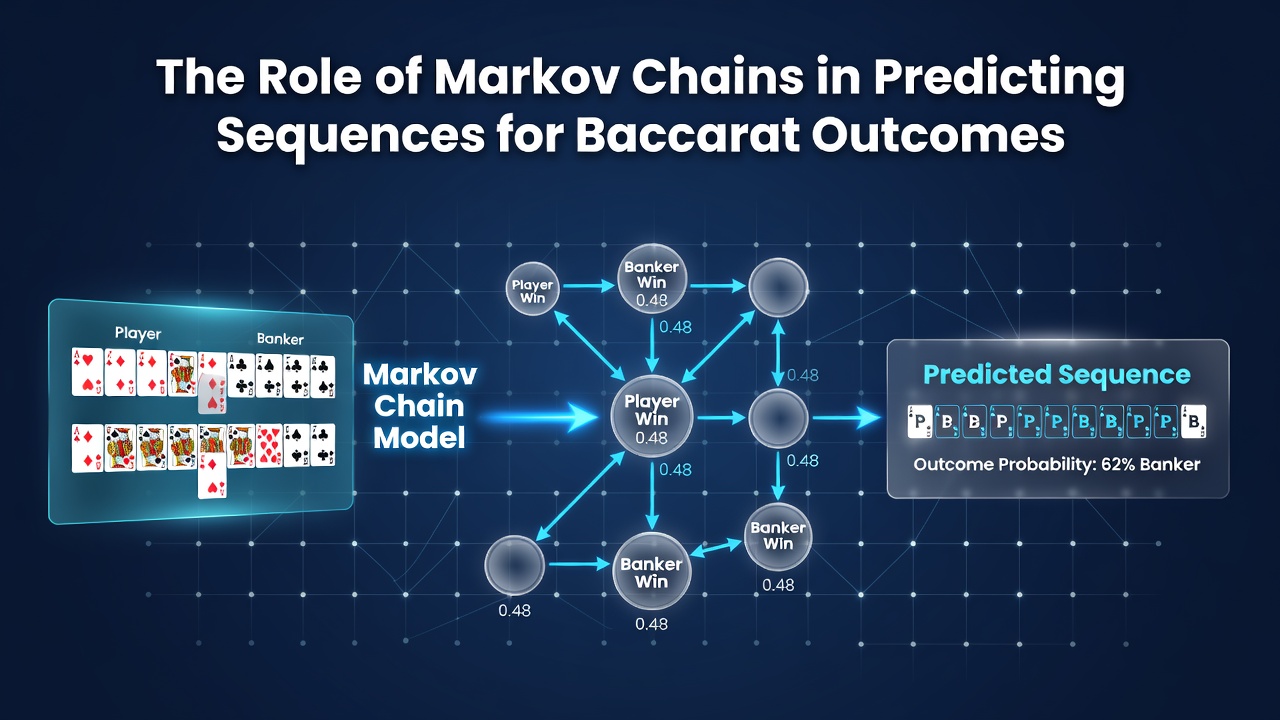
Markov chains provide a mathematical framework for analyzing sequences where each outcome depends only on the current state rather than the full history of prior events, and this approach has found application in casino games like baccarat because the composition of the remaining deck influences future probabilities. Researchers in probability theory have long examined how finite state machines capture the shifting odds across multiple hands, particularly when an eight-deck shoe is in play and cards are removed without replacement until the cut card appears.
Core Principles of Markov Chains in Sequence Prediction
A Markov chain consists of states connected by transition probabilities, where the next state depends solely on the present one, and this memoryless property aligns with baccarat because the probability of banker, player, or tie shifts based on the exact cards still available rather than earlier results in isolation. Observers note that the state space can be defined by the count of each card rank remaining in the shoe, though full enumeration becomes computationally intensive, leading analysts to group states by key factors such as the number of high cards, aces, and twos through sevens that affect drawing rules.
Data from simulation studies indicates that transition matrices can be constructed to represent the likelihood of moving from one deck composition to another after each resolved hand, and these matrices allow computation of expected frequencies for banker and player wins over the course of an entire shoe. Academic sources including papers published in the Journal of Gambling Studies have detailed algorithms that update state probabilities in real time as cards are revealed, giving a dynamic view of edge fluctuations that static house-edge calculations overlook.
Baccarat Mechanics and State Dependencies
Baccarat follows fixed drawing rules that create conditional dependencies once the initial two cards for player and banker are dealt, and the need for a third card in certain totals introduces further branching that Markov models handle through expanded state definitions. Those who have studied the game point out that ties occur at a consistent rate near 9.5 percent across full shoes, yet the conditional probability of banker or player wins varies measurably as low cards are depleted faster than high cards or vice versa.
Constructing Transition Matrices for Practical Use
Analysts build transition matrices by enumerating possible card removals and recalculating the probabilities for each subsequent hand, which produces a chain that tracks cumulative expectations rather than isolated outcomes. Evidence from computational experiments shows that early shoes with balanced decks maintain near-standard probabilities, while later portions exhibit measurable drifts once the remaining cards skew toward particular ranks, and software implementations now update these matrices after every hand to reflect the current state.
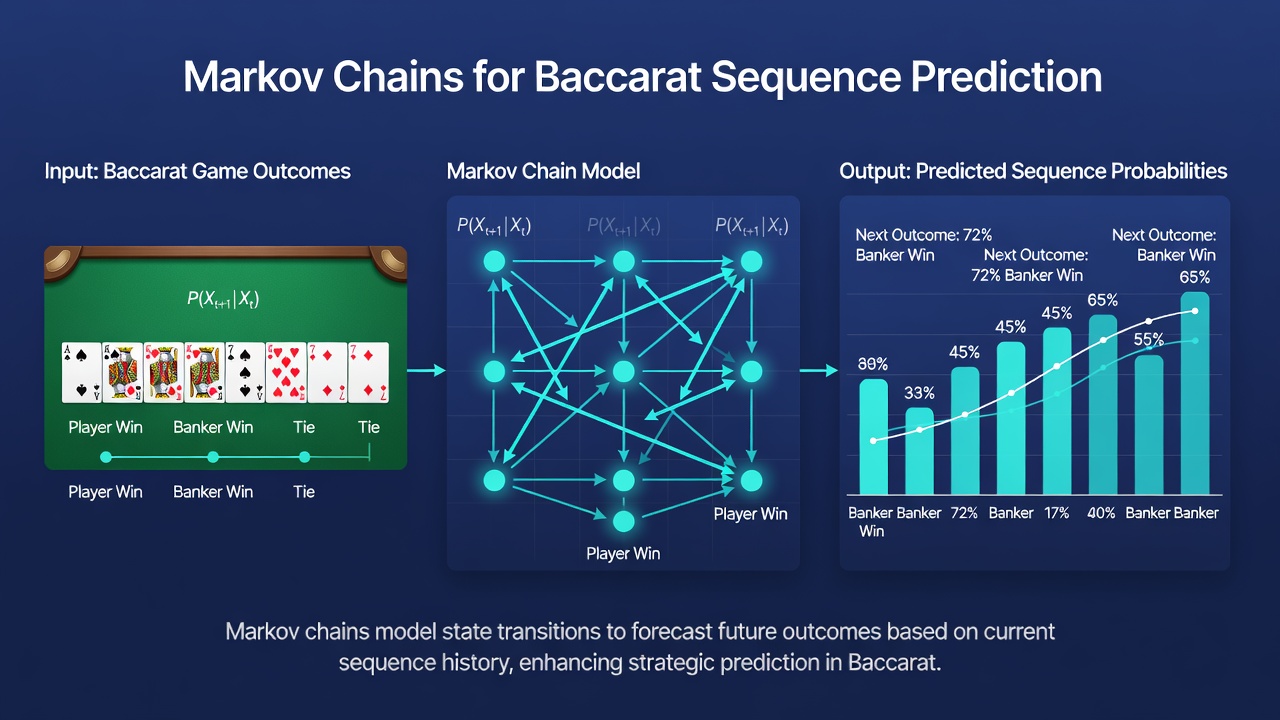
Industry reports from the Nevada Gaming Control Board have recorded average shoe durations and hand counts that align with the number of transitions a Markov model would process before reshuffling occurs, providing empirical benchmarks for validating simulation accuracy. As of October 2026, several research groups have published updated transition tables derived from millions of simulated shoes that incorporate both standard and commission-free baccarat variants, allowing direct comparison of state evolution under different rule sets.
Limitations and Computational Considerations
Markov chain applications face constraints when the state space grows too large, since tracking every possible combination of remaining cards requires substantial memory and processing power even with modern hardware. Those who have implemented these models report that aggregation techniques, such as tracking only the counts of critical card groups rather than individual ranks, reduce complexity while preserving most of the predictive signal, although some resolution is inevitably lost.
External validation against live play data remains essential because theoretical transitions assume perfect adherence to drawing rules and accurate card tracking, conditions that may diverge in actual casino environments where multiple decks and frequent reshuffles alter the chain length. A study hosted by the International Centre for Gaming Studies compared Markov-derived forecasts against recorded outcomes from regulated venues and found close agreement during the middle portions of shoes, with divergence appearing primarily near the cut card when fewer cards remain.
Integration With Existing Analytical Tools
Markov models complement rather than replace traditional counting methods used in baccarat, and practitioners often combine both approaches to generate probability estimates that update continuously throughout a shoe. Figures released by the Australian Gambling Research Centre indicate that operators tracking similar state-based metrics have observed stable participation rates even as analytical software becomes more accessible to players through mobile applications.
Further refinement occurs when models incorporate commission structures and side bet payouts, because each additional wager type expands the transition matrix to include new payoff branches that affect overall expected value calculations. Researchers continue to explore reduced-order approximations that maintain accuracy for real-time decision support while fitting within the processing limits of handheld devices commonly used trackside.
Conclusion
Markov chains supply a structured method for representing the evolving probabilities that characterize baccarat sequences, and ongoing computational advances have made these techniques more practical for detailed analysis. Data from regulatory sources and academic investigations demonstrate measurable shifts in outcome likelihoods tied to deck composition, while highlighting the trade-offs between model complexity and predictive precision. Continued development in this area focuses on efficient state aggregation and integration with live data feeds, supporting more granular examination of sequence behavior across different baccarat formats and jurisdictions.